The quick take
Choose over-ear for long, stationary listening when you value spacious comfort and larger controls; choose in-ear for commuting, exercise, and a pocketable kit—provided the tips fit securely.
- Fit and passive isolation strongly influence the result of active noise cancellation.
- Microphone quality, transparency mode, wind behavior, and multipoint support deserve a real test call.
- Noise cancellation can make lower listening levels practical, but it does not remove the need for safe volume habits.
Choose the form before comparing algorithms
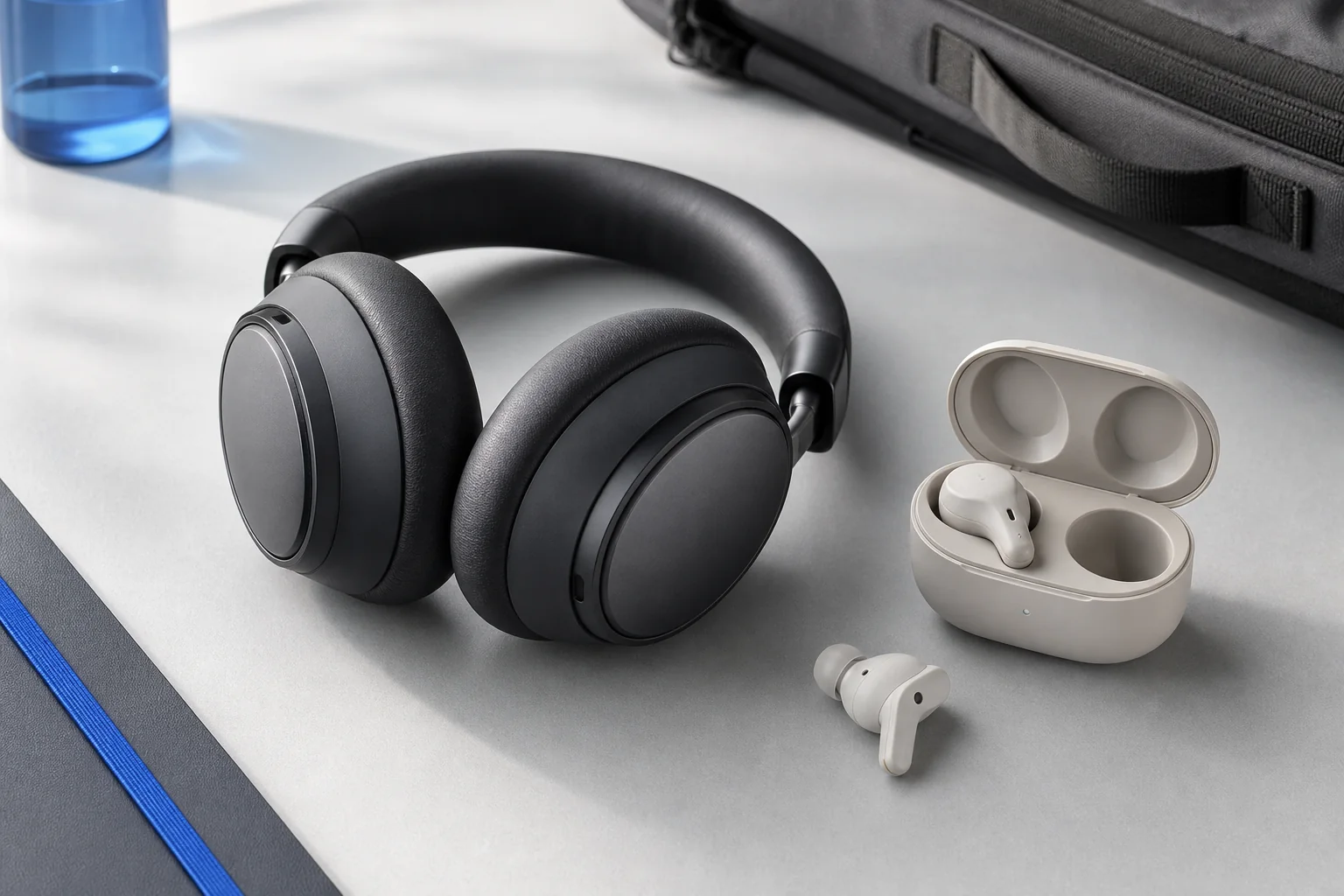
Over-ear headphones surround the ear with padded cups and a headband. In-ear models seal at the ear canal with replaceable tips. Both can use microphones and signal processing to reduce steady external noise, but the physical fit creates the starting condition. A loose ear tip or a gap around glasses can reduce isolation before the electronics have a chance to help. Comfort and seal are therefore performance factors, not cosmetic preferences.
A useful over-ear vs in-ear noise-cancelling headphones comparison begins with where and how long you listen. A home worker may wear one device for several hours and keep it on a desk. A commuter may need something that disappears into a pocket. A traveler may want strong low-frequency noise reduction but also needs to sleep, talk to staff, and pack lightly. There is no single form that wins all of those situations.
Comfort is personal and changes over time
Over-ear designs distribute contact across the head and around the ears. Soft pads can feel comfortable for long sessions, but clamping force, heat, glasses, head shape, and cup depth matter. A model that feels plush for ten minutes can become warm or create pressure after two hours. Replaceable pads are valuable for longevity because the cushion surface and foam eventually wear.
In-ear models avoid a headband and can be lighter, but the ear tips create pressure in a smaller area. Tip size and material affect stability, bass response, and isolation. Try every included size, and consider left and right ears separately. An earbud that constantly needs reseating will undermine noise control and call quality. People with irritation, pain, or ear-health concerns should stop use and seek appropriate professional advice.
Portability, battery, and charging routine
In-ear products have the clearest portability advantage. The charging case fits in a pocket, protects the earbuds, and can provide several refills. The compromise is managing three batteries—the two earbuds and the case—and handling very small pieces. Battery aging can be noticeable because the cells are tiny and often not user replaceable. Check whether either earbud can work alone and whether the case supports the charging connector you already carry.
Over-ear models occupy more space even when the cups fold. Their larger battery can support long sessions without a case, and a cable may offer a backup listening path on some models. Verify whether active noise cancellation works in wired mode and whether the headset can be used while charging. For travel, compare the full case dimensions rather than the bare headphone weight; a rigid protective case can take a meaningful portion of a small bag.
Calls, transparency, and daily switching
Call quality depends on microphone placement, processing, wind, background voices, and the connected app—not just the number of microphones. Over-ear headsets can place microphones farther from the mouth unless they include a boom, while in-ear models have limited space and may process speech aggressively. Make a test call outdoors and in a room with another person speaking. A clear recording in silence proves very little about a commute.
Transparency or ambient mode should sound natural enough that you will actually use it near traffic, announcements, and coworkers. Check how quickly it activates and whether loud sudden sounds become uncomfortable. Multipoint connection can simplify switching between a laptop and phone, but implementations differ. Some devices pause one source reliably; others require manual intervention. These workflow details often matter more than a small difference in maximum cancellation.
Safe listening still matters
Noise cancellation can help you hear content without competing against a loud background, which may make a lower volume comfortable. It is not hearing protection unless the product is specifically designed and certified for that purpose. The World Health Organization advises keeping personal-device volume below 60% of maximum as a simple rule, limiting listening time, taking quiet breaks, and using well-fitted noise-cancelling headphones where appropriate.
Volume percentages are only a rough consumer control because devices and recordings vary. Use built-in exposure monitoring when available, pay attention to warnings, and reduce both level and duration. Ringing, muffled hearing, discomfort, or persistent symptoms deserve a break and professional attention. The best over-ear vs in-ear noise-cancelling headphones choice should support safer habits rather than encouraging you to mask every environment with louder audio.
A practical decision rule
Choose over-ear if your main use is focused work, long flights, or extended listening in a stable place and you tolerate the size and warmth. Choose in-ear if you move frequently, value a pocketable case, or need a secure option for walking and exercise. For either type, fit comes before feature count. Buy from a seller with a sensible return policy so you can assess comfort, seal, calls, and controls in your own routine.
When comparing over-ear vs in-ear noise-cancelling headphones, create a short test: wear them for an hour, switch between quiet and noisy spaces, join a call, activate transparency, connect a second device, and pack the full kit. Note friction rather than chasing a single score. The right choice is the one you can wear comfortably, operate without thought, and listen to at a reasonable level in the places that matter.
Sources & editorial notes
This guide is based on published documentation and editorial analysis. It does not claim hands-on product testing. Sources were reviewed on 2026-08-03.